
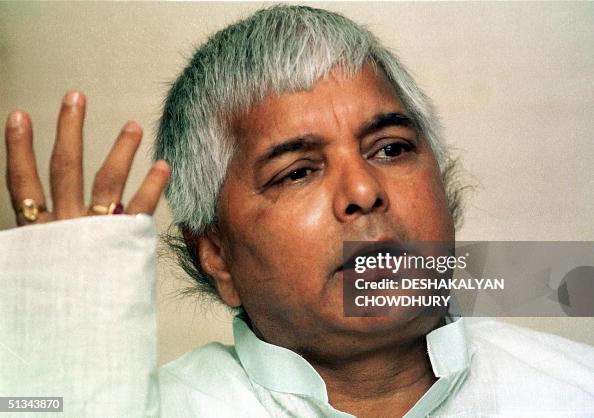
Lalu Prasad Yadav
Chief Minister of Bihar  India
India
Sexist remark about women’s rally (2024)
In December 2024, while speaking about a planned women’s rally ("Mahila Samwad Yatra") by the Bihar Chief Minister Nitish Kumar, Lalu reportedly said:
"Nain sekne ja rahe hain…" - suggesting that the rally was going so men could ogle women.
"Nain sekne ja rahe hain…" - suggesting that the rally was going so men could ogle women.
- The remark was widely condemned as sexist.
- The JDU and BJP demanded apology, saying such language was below the belt.
- This is an example where his rhetoric shifted from castepolarity to gender-sensitivities - and he was criticised accordingly.
Land for Jobs Scam (2022)
The scam alleges that during the period when Lalu Prasad Yadav was Union Railway Minister (2004-2009), certain Group D "substitute" jobs in various zones of Indian Railways were given to candidates in exchange for land transfers to the Yadav family or their associates.
The process: Aspirants (or their family) transferred land parcels-often at heavily discounted rates or as gifts-to the family/associates of Lalu Prasad Yadav / his company. In return they got jobs (appointments) in the Railways without proper advertisement / following normal norms.
Candidates were allegedly appointed as "substitutes" in different Railway zones (outside their home state) in a short time ("undue haste"), later regularised. The land transfers were done in favour of the family/company linked to Lalu Prasad Yadav.
The investigation agencies (Central Bureau of Investigation “CBI”, Enforcement Directorate "ED") allege that this mechanism amounted to corruption / criminal conspiracy / cheating / forgery under the Prevention of Corruption Act, 1988, etc.
The value and scale: Land parcels transferred are said to be high value (in Patna / Bihar) and over-time the market value is much higher than what was paid.
Political ramifications: The case involves high-profile figures (Lalu Prasad Yadav, his family, associates) and is a politically sensitive corruption case in Bihar / Railways.
The process: Aspirants (or their family) transferred land parcels-often at heavily discounted rates or as gifts-to the family/associates of Lalu Prasad Yadav / his company. In return they got jobs (appointments) in the Railways without proper advertisement / following normal norms.
Candidates were allegedly appointed as "substitutes" in different Railway zones (outside their home state) in a short time ("undue haste"), later regularised. The land transfers were done in favour of the family/company linked to Lalu Prasad Yadav.
The investigation agencies (Central Bureau of Investigation “CBI”, Enforcement Directorate "ED") allege that this mechanism amounted to corruption / criminal conspiracy / cheating / forgery under the Prevention of Corruption Act, 1988, etc.
The value and scale: Land parcels transferred are said to be high value (in Patna / Bihar) and over-time the market value is much higher than what was paid.
Political ramifications: The case involves high-profile figures (Lalu Prasad Yadav, his family, associates) and is a politically sensitive corruption case in Bihar / Railways.
Patna Land Scam (2000s)
While Lalu Prasad Yadav was Union Railway Minister (2004‑09) he is accused of granting favourable contracts to a private firm for two railway‑run hotels (in Ranchi & Puri) via Indian Railway Catering and Tourism Corporation (IRCTC).
In return, the allegation goes: a 3‑acre plot of prime land in Patna was transferred to a company friendly to his family at a much lower value than market/circle rate.
The land deal: On 25 February 2005, the land was sold to “Delight Marketing” for ~ ₹1.47 crore, though circle/market value was far higher.
The land then changed hands (between 2010‑14) and ended up in name of a company owned by the Yadav family or associates.
In return, the allegation goes: a 3‑acre plot of prime land in Patna was transferred to a company friendly to his family at a much lower value than market/circle rate.
The land deal: On 25 February 2005, the land was sold to “Delight Marketing” for ~ ₹1.47 crore, though circle/market value was far higher.
The land then changed hands (between 2010‑14) and ended up in name of a company owned by the Yadav family or associates.
Corruption in the Bihar Liquor Policy (2015-2017)
In December 2015 the Bihar government notified a "New Excise Policy (NEP) 2015" which planned a phased prohibition: ban on country‑(spiced) liquor from 1 April 2016 and later full prohibition including IMFL.
There were audit findings by the Comptroller and Auditor General of India (CAG) pointing to irregularities in the excise department: e.g. short realisation of licence fees, non‑compliance of rules for excise shops, possible revenue loss.
Critics highlight a "parallel economy" emerging under prohibition: illegal liquor supply, involvement of mafia/police, confiscated liquor being resold, etc.
One audit report noted that the company responsible for retail IMFL shops under the policy invited tenders in Dec 2015, awarded work in Feb 2016, then the policy banned IMFL sales from 5 April 2016 - leading to termination of contracts and possible loss.
The policy also had social aims (reducing alcohol consumption, domestic violence etc) but the enforcement and implementation raised transparency and governance concerns.
In sum: The policy shift toward prohibition created large disruptions in the excise/licensing ecosystem. Because revenue flows and licensing practices changed rapidly, many audits flagged rule‑violations, short‑levies, weak monitoring, and the rise of illicit supply as indicators of corruption risk.
There were audit findings by the Comptroller and Auditor General of India (CAG) pointing to irregularities in the excise department: e.g. short realisation of licence fees, non‑compliance of rules for excise shops, possible revenue loss.
Critics highlight a "parallel economy" emerging under prohibition: illegal liquor supply, involvement of mafia/police, confiscated liquor being resold, etc.
One audit report noted that the company responsible for retail IMFL shops under the policy invited tenders in Dec 2015, awarded work in Feb 2016, then the policy banned IMFL sales from 5 April 2016 - leading to termination of contracts and possible loss.
The policy also had social aims (reducing alcohol consumption, domestic violence etc) but the enforcement and implementation raised transparency and governance concerns.
In sum: The policy shift toward prohibition created large disruptions in the excise/licensing ecosystem. Because revenue flows and licensing practices changed rapidly, many audits flagged rule‑violations, short‑levies, weak monitoring, and the rise of illicit supply as indicators of corruption risk.
Tata Telecommunication Scam (2007)
The Tata Telecommunication Scam (2007) involved a ₹1,700 crore deal between Tata Realty and Unitech Group, which investigators later said was a "dubious and disguised" land deal possibly used to fund telecom licence applications (linked to the 2G spectrum scam). The Tata Group denied wrongdoing, calling it a genuine real-estate investment.
Revealed: Publicly reported by Economic Times on 3 October 2013, when the SFIO flagged the deal as suspicious.
Lalu Prasad Yadav connection:
Revealed: Publicly reported by Economic Times on 3 October 2013, when the SFIO flagged the deal as suspicious.
Lalu Prasad Yadav connection:
There’s no verified direct link between Lalu Yadav and this Tata-Unitech telecom deal. However, political opponents alleged that Lalu gave undue favours to Tata companies in exchange for property benefits, though no formal case or legal proof ties him to this 2007 transaction.
Railway Recruitment Scam (2008)
The scam involved major irregularities in recruitment examinations conducted by the Railway Recruitment Board (RRB) for posts such as Assistant Loco Pilot (ALP) and Assistant Station Master (ASM).
The modus operandi included leaking of question papers ahead of the exam, collusion of officials, agents receiving bribes (for example ~ ₹3.5 lakh per candidate in one case).
"Each candidate had to pay to the tune of Rs 3.5 lakh for getting selected" according to the investigating agency.
Huge scale: one parliamentary document notes an exam scheduled for 27 April 2008 in Bhopal was leaked and was under investigation.
The revelation triggered investigations by the Central Bureau of Investigation (CBI) and state police forces into recruitment irregularities across multiple zones.
Impact: It undermined confidence in recruitment fairness, forced cancellation of exams in some cases, and highlighted deep corruption networks in examination and appointment processes.
The modus operandi included leaking of question papers ahead of the exam, collusion of officials, agents receiving bribes (for example ~ ₹3.5 lakh per candidate in one case).
"Each candidate had to pay to the tune of Rs 3.5 lakh for getting selected" according to the investigating agency.
Huge scale: one parliamentary document notes an exam scheduled for 27 April 2008 in Bhopal was leaked and was under investigation.
The revelation triggered investigations by the Central Bureau of Investigation (CBI) and state police forces into recruitment irregularities across multiple zones.
Impact: It undermined confidence in recruitment fairness, forced cancellation of exams in some cases, and highlighted deep corruption networks in examination and appointment processes.
Fodder Scam (1990s)
The Fodder Scam refers to a series of corruption cases in the (then) undivided state of Bihar, India, mainly during the late 1980s and early 1990s.
In essence, large-scale embezzlement of public funds occurred: money withdrawn from government treasuries in the name of purchasing cattle fodder, medicines, equipment etc., for animal-husbandry and related departments, but in many cases the companies/suppliers were fictitious or bills inflated.
The amount involved is estimated to be about ₹ 950 crore (approx) in some of the major cases.
The scandal implicated high-ranking politicians and bureaucrats, including former Chief Ministers of Bihar.
It had a big political fallout in Bihar: it damaged public perceptions of governance, impacted the ruling parties, and led to multiple criminal prosecutions.
In essence, large-scale embezzlement of public funds occurred: money withdrawn from government treasuries in the name of purchasing cattle fodder, medicines, equipment etc., for animal-husbandry and related departments, but in many cases the companies/suppliers were fictitious or bills inflated.
The amount involved is estimated to be about ₹ 950 crore (approx) in some of the major cases.
The scandal implicated high-ranking politicians and bureaucrats, including former Chief Ministers of Bihar.
It had a big political fallout in Bihar: it damaged public perceptions of governance, impacted the ruling parties, and led to multiple criminal prosecutions.