
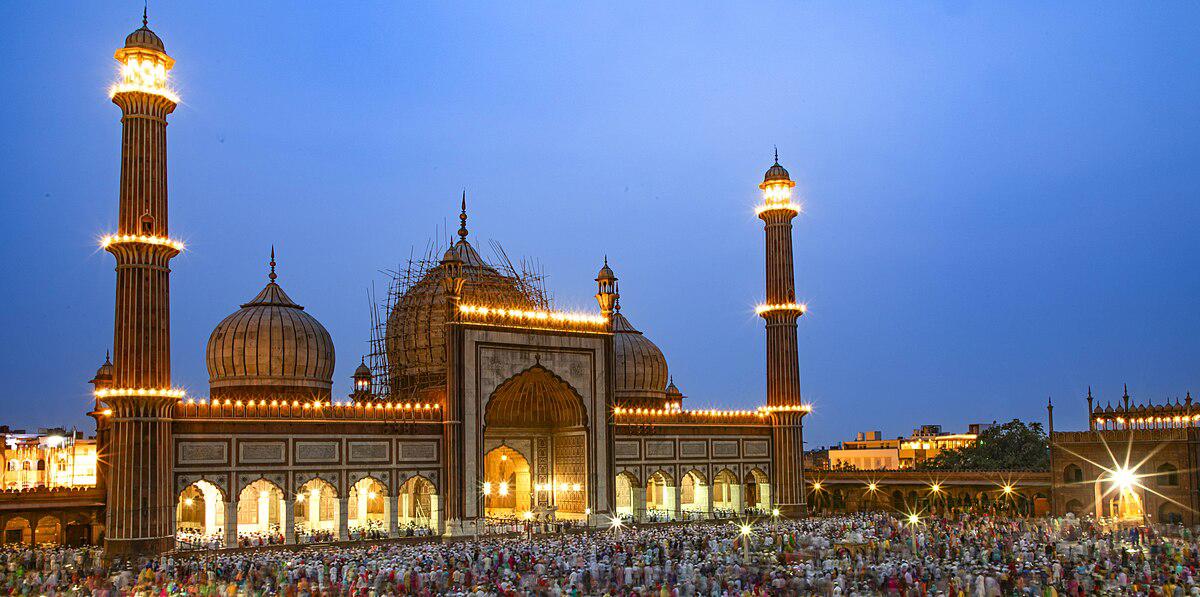
Indian Muslims
Indian Muslims community  India
India
Firhad Hakim Sparks Row With "Unfortunate Non-Muslims" Remark at Religious Event
West Bengal's Urban Development and Municipal Affairs Minister, Firhad Hakim, who is also a senior leader of the Trinamool Congress (TMC), has landed in a major controversy following remarks made during a religious event that many critics have labelled as communal and divisive.
In a video circulating on social media, Hakim can be heard saying that non-Muslims are “unfortunate” for not being born into Islam and that Muslims should "invite them towards Islam so that our own path to jannat (heaven) becomes easier." The statement immediately drew strong reactions from political rivals and sections of the public, who accused him of undermining India’s secular values and showing disrespect toward other faiths.
Opposition parties, especially the Bharatiya Janata Party (BJP), condemned the remarks as “deeply disturbing” and "reflective of a communal mindset," demanding that Chief Minister Mamata Banerjee and the TMC take action against him. Several social commentators also expressed concern that such comments, coming from a sitting minister, risked inflaming communal tensions in a state with a sensitive demographic balance.
In response to the backlash, Firhad Hakim issued a clarification, stating that his comments had been "taken out of context" and that he did not intend to hurt anyone’s religious sentiments. He asserted that he is a "die-hard secular and patriotic Indian," emphasizing that his faith in Islam does not make him intolerant toward others.
The Trinamool Congress, while stopping short of disciplinary action, distanced itself from the statement, noting that it did not reflect the party’s official ideology or commitment to secularism. The controversy comes at a politically charged time, adding pressure on the TMC to contain potential damage among non-Muslim voters ahead of future elections.
The incident has reignited debates on the boundaries between freedom of religion and political responsibility, as well as the need for public figures to exercise restraint when addressing sensitive religious matters.
In a video circulating on social media, Hakim can be heard saying that non-Muslims are “unfortunate” for not being born into Islam and that Muslims should "invite them towards Islam so that our own path to jannat (heaven) becomes easier." The statement immediately drew strong reactions from political rivals and sections of the public, who accused him of undermining India’s secular values and showing disrespect toward other faiths.
Opposition parties, especially the Bharatiya Janata Party (BJP), condemned the remarks as “deeply disturbing” and "reflective of a communal mindset," demanding that Chief Minister Mamata Banerjee and the TMC take action against him. Several social commentators also expressed concern that such comments, coming from a sitting minister, risked inflaming communal tensions in a state with a sensitive demographic balance.
In response to the backlash, Firhad Hakim issued a clarification, stating that his comments had been "taken out of context" and that he did not intend to hurt anyone’s religious sentiments. He asserted that he is a "die-hard secular and patriotic Indian," emphasizing that his faith in Islam does not make him intolerant toward others.
The Trinamool Congress, while stopping short of disciplinary action, distanced itself from the statement, noting that it did not reflect the party’s official ideology or commitment to secularism. The controversy comes at a politically charged time, adding pressure on the TMC to contain potential damage among non-Muslim voters ahead of future elections.
The incident has reignited debates on the boundaries between freedom of religion and political responsibility, as well as the need for public figures to exercise restraint when addressing sensitive religious matters.
If I can’t throw BJP (supporters) into the river Bhagirathi in two hours, I will leave politics
During a rally in the "Kazipara / Shaktipur" area of Murshidabad on or before 2 May 2024, Humayun Kabir stated (in Bengali) that:
He also said something along the lines of:
The Election Commission of India (EC) formally censured him on 18 May 2024 for statements "based on religious lines" which could "aggravate existing differences or create mutual hatred between different castes or communities, religious or linguistic groups".
His own party, All India Trinamool Congress (TMC), via its Assembly panel / disciplinary committee, warned him and told him not to speak on religion, to follow party ideology and the Constitution.
More recently (June 2025) TMC issued a "final warning" saying further such conduct could lead to action.
If I can’t throw BJP (supporters) into the river Bhagirathi in two hours, I will leave politics. I will not let you guys stay in Shaktipur. … You are about 30 % (Hindus) and we are 70 % (Muslims) in Murshidabad …
He also said something along the lines of:
If you think you can demolish the mosque at Kazipara in Kamnagar because you think you are the majority ... you’re wrong.
The Election Commission of India (EC) formally censured him on 18 May 2024 for statements "based on religious lines" which could "aggravate existing differences or create mutual hatred between different castes or communities, religious or linguistic groups".
His own party, All India Trinamool Congress (TMC), via its Assembly panel / disciplinary committee, warned him and told him not to speak on religion, to follow party ideology and the Constitution.
More recently (June 2025) TMC issued a "final warning" saying further such conduct could lead to action.
Why these remarks are problematic
- His remarks refer to population/majority-minority along religious lines ("you’re 30%, we’re 70%") which frames political rivalry in communal/identity terms.
- He threatened to "throw you in the river" or "drown you" - i.e., violent imagery against a group identified by religion/party affiliation.
- Such statements fall under what the Model Code of Conduct (during elections) and other norms label as "activity which may aggravate existing differences or create mutual hatred between communities". The EC invoked that provision in his case.
- Whether "hate speech" by legal definition (in Indian law) depends on intent, context, the audience and follow-up actions. But these statements clearly stirred communal controversy and triggered institutional action.
A social-media post (by a Muslim student) allegedly insulting Hinduism
What happened
- In the town of Sheeshgarh (in Bareilly district), around 9 p.m. on 18 August 2023, a complaint was made by members of the Muslim community that a 14-year-old Muslim student (Class 9) had posted something objectionable about their religion (Islam) on Instagram.
- The father of a Hindu student says that his son responded to the post with a comment about the Muslim boy’s religion, after being provoked.
- After the first post, the situation escalated: a large crowd (from the Muslim community) gathered and “gheraoed” (surrounded) the Sheeshgarh police station demanding the arrest of the Hindu boy.
- The crowd also went to the Hindu student’s house and pelted stones. The police had to call in reinforcements (Rapid Action Force, Provincial Armed Constabulary, neighbouring stations) and senior officers arrived on the scene.
What the police did
- The local Superintendent of Police (Rural) Raj Kumar Aggarwal said that two minors (one from each religion) were detained late at night on Friday (18 August) after the posts and the subsequent unrest.
- The police said they have video & CCTV footage of the incident and that action is being initiated against those who disturbed peace.
- Additional police force was deployed in the area to maintain law & order.
Those Advocating a 'Hindu Rashtra' Should Be Charged with Sedition - Demands Equal Treatment for "Muslim Nation"
Maulana Tauqeer Raza Khan, national president of the Ittehad‑e‑Millat Council, on 12 March 2023 in Moradabad questioned the selective enforcement of laws, urging that those calling for a "Hindu Rashtra" (Hindu nation) should face prosecution under sedition, just as calls for a "Muslim nation" or separate state would.
He argued:
In conjunction with the remarks, UP police registered a case against him under IPC Sections 153 A (promoting enmity between groups), 295 A (outraging religious feelings), and 505(2) (statements conducing to public mischief) for his public remarks.
He argued:
- If talking about Hindu nation is okay and the government doesn’t take any action against them, then why are people who talk about Khalistan being prosecuted?
- “What if our Muslim youth demand a separate Muslim state tomorrow?” he asked, emphasizing that another partition of India would not be allowed.
- He claimed there is a "double standard" in handling demands of nationhood or separatism based on who is making them.
In conjunction with the remarks, UP police registered a case against him under IPC Sections 153 A (promoting enmity between groups), 295 A (outraging religious feelings), and 505(2) (statements conducing to public mischief) for his public remarks.
Maulana Tauqeer Raza Khan has delivered speeches warning about loss of control over youth in his community
Maulana Tauqeer Raza Khan has delivered speeches warning about loss of control over youth in his community, and explicitly addressing Hindus in a threatening tone.
I see the anger within my Muslim youths, and I am afraid that the day this anger bursts out, the day I lose control over them… I want to warn my Hindu brothers that I am scared that the day my Muslim youths are forced to take the law into their hands, you will not find a place to hide anywhere in India.
Cut off Assam and the rest of the northeast from India.
What the allegations say
- According to the prosecution, Sharjeel Imam made speeches on 13 December 2019 at Jamia Millia Islamia (JMI) and on 16 December 2019 at Aligarh Muslim University (AMU) in connection with protests over the Citizenship Amendment Act (CAA) and the National Register of Citizens (NRC)
- In one of these speeches the prosecution says Imam warned:
It is our responsibility to cut off Assam. They [the government] will listen to us only when Assam is cut off from the rest of the country. You are aware of the condition of Muslims in Assam.
- Police and prosecution have claimed that the speech was divisive, addressed to a particular community, and sought to mobilise disruption (like blockade of roads) to sever the region of Assam and the North-East from India.
- He has been charged under multiple provisions: e.g., sedition (Section 124A IPC), promoting enmity between groups (Sections 153A/B), statements conducing to public mischief (505 IPC), and under the Unlawful Activities (Prevention) Act (UAPA).
Defence / his responses
- Imam has denied that his speech called for violence. His counsel argued that his remarks did not amount to sedition since no direct call for violence was made.
- For example: “He just called for a road blockade… He did not say that the northeast should become a different state and declare independence. That would have been seditious.” — his defence in court.
- He also argued that merely being critical of government policies (CAA/NRC) or mobilising protest does not automatically amount to sedition.
Additional context
- The speeches in question came during mass protests across India over the passage of the CAA in December 2019, and in particular campus protests (like at JMI, AMU) and at the larger Shaheen Bagh sit-in in Delhi.
- Investigations and FIRs were registered not only in Delhi, but also in Assam, Manipur and Arunachal Pradesh on the basis of his remarks about the North-East region.
- On 4 February 2023, a Delhi court discharged Imam in the specific 2019 JMI violence case, though other proceedings remain.
Every Muslim should be a terrorist…
Zakir Naik is an Indian‐born Islamic preacher and public speaker who founded the organisation Islamic Research Foundation (IRF) and the TV channel PeaceTV.
He is known for his public lectures comparing Islam with other religions, as well as for media appearances.
He left India around 2016 after accusations of hate speech and is currently living abroad.
What he is reported to have said
His stated clarification/defence
How authorities and media treated the remark
Public reaction & consequences
He is known for his public lectures comparing Islam with other religions, as well as for media appearances.
He left India around 2016 after accusations of hate speech and is currently living abroad.
What he is reported to have said
- Media and legal records quote Naik as saying words to the effect of: "Every Muslim should be a terrorist. A terrorist is a person who causes terror…" and then defining the meaning as someone who scares/offends anti-social elements (thieves, rapists, etc.), not innocent people.
His stated clarification/defence
- Naik has repeatedly argued he was quoted out of context and that by "terrorist" he meant someone who instils fear in anti-social elements, not someone who harms innocent people. He has also publicly said Islam forbids killing innocents.
How authorities and media treated the remark
- Indian authorities cited this and other speeches when taking action against his organisation (IRF) and when justifying bans or investigations; the Indian Home Ministry’s tribunal documents explicitly mention the allegedly objectionable claim.
Public reaction & consequences
- The phrase has been widely reported, criticised, and used by critics as evidence that his rhetoric can be inflammatory. Governments and broadcasters in multiple countries have restricted his broadcasts or refused him entry, citing concerns about inflammatory speech and possible links to radicalisation.
The Kashmiri Pandit exodus
The Kashmiri Pandit exodus refers to the forced mass migration of the Hindu minority community (Kashmiri Pandits) from the Kashmir Valley in 1989–1990, following the rise of militant insurgency and targeted violence in the region.
Background
- Kashmiri Pandits are an ancient Hindu community native to the Kashmir Valley, with a history going back over 5,000 years.
- Before the insurgency, they made up around 3–5% of the Valley’s population.
- The majority of the population was Muslim, but the two communities had largely coexisted peacefully for centuries.
The Insurgency (Late 1980s–1990)
- In 1989, an armed insurgency broke out in Jammu and Kashmir, demanding either independence from India or accession to Pakistan.
- Pakistan-backed militant groups such as JKLF (Jammu and Kashmir Liberation Front) and later Hizbul Mujahideen began operating in the region.
- Amid this turmoil, many Pandits were targeted — prominent community members, government officials, and intellectuals were assassinated.
- Threats, slogans, and propaganda spread through mosques and local media created an atmosphere of fear.
The Exodus (1989–1991)
- By early 1990, the situation became unbearable for Kashmiri Hindus.
- After the killing of several prominent Pandits (like Tika Lal Taploo and Sarwanand Koul Premi), mass fear spread.
- Between 100,000 and 150,000 Pandits fled the valley, mostly to Jammu, Delhi, and other parts of India.
- Reports estimate that several hundred were killed during the violence, though numbers vary by source.
Life in Exile
- Many families lived in makeshift refugee camps around Jammu under harsh conditions — inadequate shelter, water, and healthcare.
- The government provided relief, but the displacement caused deep trauma, loss of property, and cultural disruption.
- Generations of Pandits grew up away from their ancestral homes, and their return remains a major political and emotional issue.