
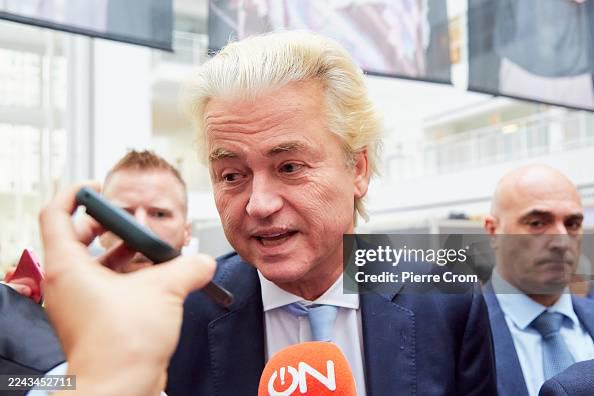
Geert Wilders
Member of the House of Representatives of the Netherlands  Netherlands
"Ban the Quran" campaign (2012 – 2015)
Key Dates & Events
- On 8 August 2007, Wilders wrote an open letter published in the Dutch daily Volkskrant calling to “ban the Quran” in the Netherlands, likening it to the ban on Mein Kampf.
- In 2013, he publicly reiterated a campaign to ban the Quran and "stop the Islamisation of the Netherlands".
- On 26 August 2016, PVV’s manifesto ahead of the March 2017 elections declared: "All mosques and Islamic schools closed, a ban on the Quran."
- Although the campaign was active during the 2012–2015 period (as the user asked), I found strongest documentation for the manifesto in 2016 (which builds on prior years) and earlier remarks in 2007.
- On 8 January 2024, Wilders announced he was withdrawing legislation (first proposed in 2018) that would ban mosques and the Quran.
What was the campaign about?
- The campaign was driven by the idea that the Quran (and more broadly Islam) is inherently violent or incompatible with Dutch society. For example, in 2007 Wilders said the Quran “contains chapters that call on Muslims to oppress, persecute or kill…” and demanded it be banned just like Mein Kampf.
- In the 2016 PVV manifesto he set out concrete policy aims: banning the Quran, closing mosques and Islamic schools, halting migration from Islamic countries.
- The campaign was mostly rhetorical and policy-platform rather than fully implemented law. Proposed legislation never achieved a parliamentary majority.
Anti-EU & "Nexit" remarks (2016–present)
Key Dates & Statements
- 7 April 2016 – Following a Dutch referendum rejecting the EU-Ukraine association agreement, Wilders tweeted that it was "the beginning of the end of the European Union."
- 22 June 2016 – Wilders called for a referendum in the Netherlands on exiting the EU ("Nexit"). He said that if the UK’s United Kingdom vote to leave were "successful," the Netherlands should follow.
- 24 June 2016 – After the UK’s Brexit vote, Wilders said:
Hurrah for the British! Now it is our turn. Time for a Dutch referendum! #ByeByeEU
- 29 June 2016 – The Dutch House of Representatives rejected a motion by Wilders for an EU-membership referendum; only 14 of 150 MPs supported it.
- March 2017 – Ahead of the Dutch general election, Wilders was quoted as calling Nexit "the best thing that could happen to the Dutch people."
- April 2024 – Wilders signalled a tactical shift: acknowledging that a Nexit referendum was unlikely, he said the aim should now be to reform the EU from within, rather than immediate exit.
- 9 September 2024 – In an interview, Wilders described the EU as a "monster" demanding ever more power and argued for returning powers to national capitals.
Key Themes in His Position
- Sovereignty & National Control: Wilders repeatedly emphasises the need for the Netherlands to have “its own money, its own borders, its own immigration policy.”
- Economic Argument for Exit: In his party’s website, the PVV claimed that leaving the EU (NExit) would boost the Dutch economy by ~10% by 2024, arguing Dutch households would on average gain about €10,000 over two decades.
- Critique of EU Integration: Wilders has framed the EU’s trajectory as one of ever-closer political union, which he rejects:
If you give it more power they only want more and they won’t give it back.
- From Exit to Reform: Although early on he pushed hard for immediate exit, more recently he has accepted that the public and political conditions for Nexit aren’t favourable, and shifted toward reforming the EU’s powers instead.
- Opposition to EU Enlargement & Migration: Wilders opposes further enlargement of the EU and has linked the EU’s migration and border rules to loss of national control.
Do you want more or fewer Moroccans in your city and in the Netherlands?
Wilders asked the audience
The crowd responded:
to which he replied
Context: This happened in the aftermath of the 2014 Dutch municipal elections, where Wilders was addressing supporters regarding his party’s stance on immigration and the presence of Moroccans in Dutch cities.
Reaction: The speech led to widespread complaints (thousands) to the Dutch Public Prosecution Service, triggering investigation for potential group insult, incitement to discrimination/hatred.
Legal outcome
Do you want more or fewer Moroccans in your city and in the Netherlands?
The crowd responded:
Fewer! Fewer! Fewer!”
to which he replied
Well, then we’ll take care of that.
Context: This happened in the aftermath of the 2014 Dutch municipal elections, where Wilders was addressing supporters regarding his party’s stance on immigration and the presence of Moroccans in Dutch cities.
Reaction: The speech led to widespread complaints (thousands) to the Dutch Public Prosecution Service, triggering investigation for potential group insult, incitement to discrimination/hatred.
Legal outcome
- In December 2016, a Dutch district court found Wilders guilty of group-insult and incitement to discrimination for the 2014 remark, though no punishment was imposed.
- On 4 September 2020, the Dutch appeals court upheld the group-insult conviction but overturned the incitement charge; still, no punishment was applied.
- On 6 July 2021, the Dutch Supreme Court (Hoge Raad) upheld the group-insult conviction, ruling that the speech was not protected under freedom of expression given its targeting of a specific group ("Moroccans").
"Fitna" film (2008)
Basic info
- Director/Producer/Issuer: Dutch politician Geert Wilders (credited) via his initiative.
- Country: Netherlands.
- Duration: ~17 minutes.
- Language: Dutch/English (and other versions).
Release & date
- The film was released online 27 March 2008 via the video-site LiveLeak.
- It was briefly removed on 28 March 2008 due to threats.
- A revised version was released 6 April 2008.
Context
- The film juxtaposes passages from the Qur’an and media imagery of terrorist attacks, making the claim that Islam is linked to violence.
- It generated international controversy and condemnation. For example, the Office of the United Nations High Commissioner for Human Rights (OHCHR) issued a statement on 28 March 2008 criticizing the film.
- A news article by Reuters on 27 March 2008 reported the film’s release and the protests.