
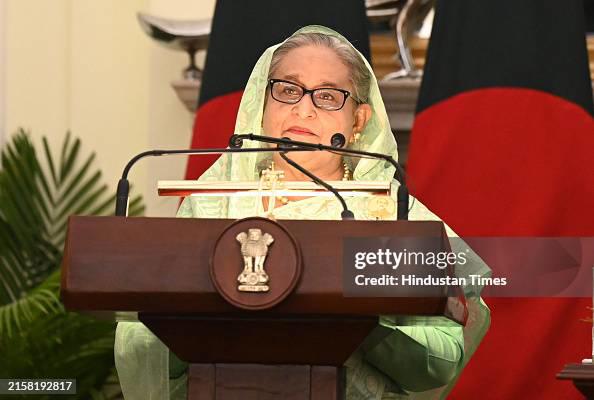
Sheikh Hasina
Prime Minister of Bangladesh  Bangladesh
RAJUK Purbachal Plot Allocation Scam (2025)
The alleged scam revolves around plot allocations under the Rajdhani Unnayan Kartripakkha (RAJUK) in the Purbachal New Town Project in Bangladesh. The key issues: misuse of power, bypassing of procedures, and allocation of high-value plots to politically influential individuals.
Key Parties
- Sheikh Hasina (former Prime Minister of Bangladesh) — named as primary accused.
- Saima Wazed Putul (her daughter) — alleged to have sought plot allocation by influencing her mother and bypassing RAJUK procedure.
- Other family members: Sajeeb Wazed Joy (her son), Sheikh Rehana (her sister), and nephews/nieces (e.g., Radwan Mujib Siddiq, Azmina Siddiq) are also implicated.
- Officials at RAJUK and the Ministry of Housing and Public Works – multiple high-ranking officials named for collusion or negligence.
What's being alleged
- According to the Anti‑Corruption Commission (ACC), plots in Purbachal (notably 10-katha plots in Sector 27, Road 203 zone) were allocated to these persons despite them being ineligible under RAJUK rules (for example, they already owned housing within RAJUK jurisdiction).
- The process is alleged to have bypassed normal RAJUK application procedures—for example, no formal application book entry, skipping of eligibility checks.
- The allocations allegedly took place “by abusing power” with collusion between the accused and RAJUK/MoHousing officials.
Timeline of major actions
- 26 December 2024: ACC launches inquiry into allocation of 60 katha (6 plots × 10 katha each) to Hasina and family.
- 12 January 2025: ACC files a case against Hasina, Saima and 14 others for “abuse of power” in Purbachal plot allocations.
- 10 March 2025: ACC submits charge sheets, adding further accused.
- 10 April 2025: Dhaka court issues arrest warrants against Hasina and 17 others.
- 27 April 2025: Court grants ACC’s request to issue an Interpol red notice for Saima Wazed Putul (living abroad) in the plot allocation case.
- 1 July 2025: Court orders newspaper advertisements summoning Hasina, her son, daughter and others in connection with five cases.
$300 Million Money Laundering Probe (2024-2025)
Key Facts
- The Anti‑Corruption Commission (Bangladesh) (ACC) has formally initiated an inquiry into allegations that Sheikh Hasina and her son Sajeeb Wazed Joy laundered about US $300 million to the United States (and/or possibly UK) via illicit channels.
- According to ACC sources, the funds are alleged to have been transferred to New York and London.
- The probe is tied to separate allegations of large‐scale corruption and embezzlement through priority development projects during the tenure of Hasina’s government (including claims of mis-appropriation of Taka 80,000 crore across nine projects) — the laundering probe appears to be one arm of a broader investigation.
- The ACC decision to probe was taken around December 2024.
What is alleged / Methodology
- The core allegation: that large sums (≈ US $300 million) of Bangladesh’s money were moved abroad (to US/UK) by the accused individuals, under circumstances suggesting abuse of power, irregularities in government contracts or allocations, and then laundering of those funds via foreign jurisdictions.
- The investigation is not yet publicly detailing exact mechanisms of how the funds were laundered (which banks, shell companies, jurisdictions). The ACC sources indicate the money was “to the US” and "to New York and London" but full disclosures are pending.
- The probe is linked to another complaint/claim regarding illicit gains via nine development projects (Tk 80,000 crore) which may have generated the funds for laundering.
Status of Investigation
- The ACC has “started” the probe; at the time of latest reports the investigation is in early stages (collection of documents, tracing funds) rather than completed or resulting in charges.
- As of the latest, there is no public record (in the sources I found) of court filings, indictments, or convictions specifically tied to the $300 m‐laundering allegation.
- Because of the high‐profile nature (a former prime minister, a prominent family), the case is drawing strong public and media attention.
- The timing: December 2024 + ongoing into 2025
Rooppur Nuclear Power Plant Corruption (2024)
Key Sources
- "Ousted Bangladesh PM Hasina's son denies graft in $12.65 billion nuclear deal" (Reuters) — detailed the official inquiry by the Anti‑Corruption Commission (ACC) into alleged US $5 billion financial irregularities.
- "City minister Tulip Siddiq named in Bangladesh corruption claim" (Financial Times) - shows the international dimension, naming UK‑based persons in the allegations.
- "Starmer backs minister accused of embezzling billions in Bangladesh" (The Guardian) — gives political/UK reaction to the allegations.
- "ACC launches probe into alleged Rooppur Nuclear Power Plant project graft" (The Business Standard) - local Bangladesh media reporting on ACC’s initiation of the probe.
Notes / Caveats
- The ACC inquiry states that information from open sources shows potential irregularities of about US $5 billion in connection with the RNPP project.
- The Russian side (via embassy/officials) has denied that any corruption opportunity exists in the export‑credit financing mechanism for the RNPP.
- Some of the initial claims (e.g., large sums siphoned via Malaysian banks) trace back to less‑verified reports, and have been challenged for lack of concrete evidence.
Important Dates
- 3 September 2024: A writ petition filed in Bangladesh’s High Court requesting ACC to act on allegations regarding the RNPP project.
- 23 December 2024: ACC formally launches an inquiry into alleged corruption/embezzlement/money‑laundering involving the RNPP project.
Extrajudicial Killings & Disappearances (2015–2022)
Bangladesh has faced long-standing concerns regarding human rights violations involving law enforcement agencies, including the Rapid Action Battalion (RAB), police, and security forces. Between 2015 and 2022, multiple reports documented extrajudicial killings, enforced disappearances, and custodial deaths.
Enforced disappearances:
Custodial deaths:
- Extrajudicial killings are killings carried out by state agents without due process.
- Enforced disappearances involve individuals being taken into custody (by or with complicity of state actors) without official acknowledgment, leaving families unaware of their fate.
Reported Numbers (2015–2022)
- According to Odhikar, between 2015–2022, over 2,500 killings were reported under "crossfire" or "gunfight" circumstances involving law enforcement.
- RAB has been implicated in the majority of these cases. Many killings were reported during anti-drug drives or alleged anti-crime operations.
- Amnesty International reports highlight systemic issues, including lack of independent investigations.
Enforced disappearances:
- Odhikar documented over 500 enforced disappearances between 2015–2022.
- Victims are often political activists, journalists, or alleged critics of the government.
- Most disappearances are attributed to security forces, often RAB or elite police units.
Custodial deaths:
- Hundreds of deaths in custody were also reported, sometimes linked to torture, lack of medical care, or neglect.