
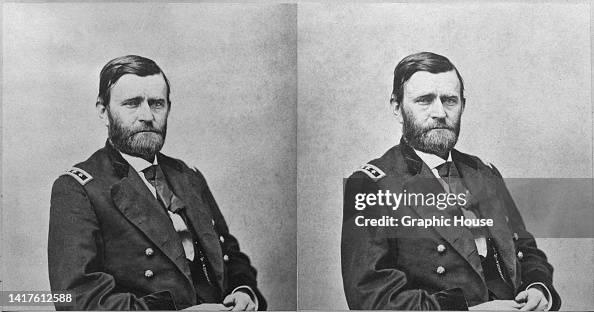
Ulysses S. Grant
18th U.S. President  United States
The Whiskey Ring (1875)
The Whiskey Ring was a large tax-evasion and bribery conspiracy (distillers + Treasury agents + local officials) that operated mainly in St. Louis (and other Midwestern cities) during Grant’s presidency. Treasury Secretary Benjamin Bristow uncovered the Ring, which was broken up by raids in May 1875; prosecutions ran through 1875–1876.
Key dates & timeline
- Formation / activity: roughly 1871–1875 (organized evasion of federal whiskey excise taxes).
- Crackdown / discovery announced: Investigations intensified in spring 1875; Bristow’s secret investigations culminated in raids and indictments by May 1875.
- Prosecutions: Indictments and trials took place 1875–1876 (many convictions followed).
- Orville Babcock trial / Grant deposition: Grant’s private secretary Orville E. Babcock was indicted and tried in February 1876; Grant provided a sworn deposition in Babcock’s defense (he nearly testified in person but was persuaded not to). Babcock was acquitted Feb 1876. (Grant’s deposition is usually dated 9 February 1876 in contemporary accounts/diaries.)
- Pardons / aftermath: John McDonald (a ring leader) was convicted but later pardoned by Grant on March 3, 1877 (Grant’s last full day in office). The Treasury recovered millions; Bristow secured many convictions (commonly cited: ~110 convictions and millions recovered).
Ulysses S. Grant - his connections & role
- Appointments and personnel ties: The Ring’s St. Louis operation was led by John McDonald, whom Grant had appointed Revenue Collector for the Missouri district (1869). Orville Babcock was Grant’s private secretary and a close friend; Babcock was alleged to have been a Washington contact/protector for the Ring.
- Administration response: Grant’s Treasury Secretary Benjamin Bristow mounted a secret investigation. Bristow prosecuted many members of the Ring - an action often credited as an important reform step in Grant’s administration.
- Personal intervention: When Babcock was indicted, Grant strongly defended him. At the urging of cabinet members (notably Secretary of State Hamilton Fish), Grant did not appear in court in person but gave a sworn deposition at the White House attesting to Babcock’s innocence; Babcock was acquitted. Historians still debate how much, if anything, Grant personally knew about the Ring’s activities.
The "Indian Ring" (Secretary of War Belknap Scandal, 1876)
Here are the key dates and details connecting Ulysses S. Grant and what’s known as the “Indian Ring” or tradership scandal involving William W. Belknap:
- On March 2, 1876, Belknap submitted his resignation as Secretary of War to President Grant amid the exposure of the tradership corruption scheme.
- On the same day (March 2, 1876), the United States House of Representatives voted unanimously to impeach Belknap.
- The U.S. Senate held his impeachment trial in May 1876 (with hearings beginning in April) and on August 1, 1876, the Senate voted to acquit Belknap because the required two-thirds majority was not reached.
The Credit Mobilier Scandal (exposed 1872)
The Credit Mobilier Scandal, exposed in 1872, was one of the most notorious political and corporate corruption scandals in 19th-century United States history.
Background
- Credit Mobilier of America was a construction company formed by major shareholders of the Union Pacific Railroad in 1864.
- Its purpose was to build the transcontinental railroad, but in reality, it was a front to siphon off huge profits from the government-funded railroad project.
How the Scheme Worked
- The Union Pacific Railroad company created Credit Mobilier, controlled by its own directors.
- They awarded construction contracts to Credit Mobilier at inflated prices - much higher than the actual cost of building the railroad.
- The federal government was paying subsidies to the Union Pacific, so the executives were essentially paying themselves with government money.
- To prevent investigation, they bribed members of Congress by selling or giving them discounted shares in Credit Mobilier.
Exposure (1872)
- The scandal broke during the Grant administration (President Ulysses S. Grant).
- The New York Sun published documents showing that several high-ranking officials, including Vice President Schuyler Colfax, Speaker of the House James G. Blaine, and future Vice President Henry Wilson, had received shares.
- Investigations followed, revealing the depth of corruption.
Consequences
- Several politicians’ reputations were severely damaged, though few faced legal punishment.
- Oakes Ames, a congressman and key figure in the scandal, was censured by the House of Representatives.
- The scandal shook public trust in the federal government and highlighted corruption during the Gilded Age.
Sanborn Incident (1874)
The Sanborn Incident (also called the Sanborn Contract scandal) was a corruption scandal in the administration of Ulysses S. Grant involving the use of private tax-collectors under the authority of the United States Department of the Treasury and its Secretary, William A. Richardson.
Although President Grant was not personally implicated in the day‐to‐day operations of this scandal, it occurred under his administration and reflected poorly on its integrity. The scandal prompted Grant to take reform-oriented actions (notably signing the legislation ending the moiety system) and to replace Richardson.
- Under a congressional provision (in an 1872 appropriations law), the Treasury Secretary was allowed to hire up to three private persons (so-called "moiety" collectors) to discover and collect unpaid federal taxes, with the private collector entitled to keep 50% of what he collected.
- On August 13, 1872, Richardson (as acting or full Secretary) entered into a contract with John B. Sanborn to collect unpaid excise and revenue taxes from certain distillers, railroads, etc. Sanborn’s mandate was later expanded to include hundreds of additional entities (including hundreds of railroads).
- Sanborn ultimately collected roughly $427,000 in delinquent taxes; under the contract he kept about $213,000 for himself (50% of the collection) and reportedly passed on large sums to others.
- A congressional investigation by the House Ways & Means Committee in early 1874 found serious fault with the supervision of the Treasury Department and Richardson’s oversight. The committee’s report was issued on May 4, 1874.
- On June 22, 1874, President Grant signed legislation (the "Anti-Moiety Acts") which effectively ended the moiety system for tax-collection and banned such private collector contracts.
- Though Richardson was never criminally convicted for wrongdoing, his reputation was damaged and he was moved to a judicial appointment (on the U.S. Court of Claims) by Grant in 1874.
Although President Grant was not personally implicated in the day‐to‐day operations of this scandal, it occurred under his administration and reflected poorly on its integrity. The scandal prompted Grant to take reform-oriented actions (notably signing the legislation ending the moiety system) and to replace Richardson.
The Gold Ring (Black Friday Scandal, 1869)
The Black Friday Scandal occurred on September 24, 1869, when two speculators, Jay Gould and James Fisk, attempted to corner the gold market, creating a financial panic. The scheme directly involved President Ulysses S. Grant’s administration, though Grant himself was not found guilty of wrongdoing.
The Scheme
- Gould and Fisk attempted to corner the gold market by buying massive amounts of gold.
- They planned to keep gold prices high by preventing government sales of gold.
- Corbin, using his connection to Grant, attempted to influence the Treasury not to sell gold.
Consequences
- Jay Gould and James Fisk avoided jail but faced public outrage.
- Some small investors lost fortunes.
- President Grant faced criticism for his administration’s lack of oversight, although investigations cleared him of personal wrongdoing.