
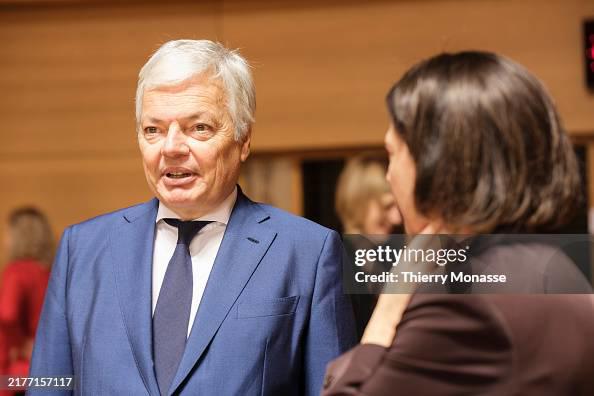
Didier Reynders
Deputy Prime Minister of Belgium  Belgium
Money Laundering via Lottery Scheme
Who?
Didier Reynders - Belgian Finance Minister, Foreign Minister, and EU Commissioner for Justice.
What He’s Accused Of:
- Belgian authorities suspect he laundered money by buying lottery tickets (especially “e‑tickets” / electronic lottery vouchers) over many years.
- The scheme, as alleged, involved depositing cash into lottery play, converting the cash into lottery “winnings,” and then transferring those purported winnings back into his bank account, thereby “cleaning” questionable cash.
- The money in question: reports suggest around €700,000 were deposited in cash into his ING account between 2008 and 2018.
- There’s also mention of €200,000 allegedly laundered via lottery purchases specifically.
- Police raids in his properties found some cash (~€7,000) during searches.
- The National Lottery itself and Belgium’s Financial Intelligence Processing Unit (CFI) reportedly filed reports about suspicious behavior.
- He was charged formally.
Time Period:
- The deposits and alleged laundering span from about 2008 to 2018.
- The investigation has been ongoing since at least 2023, according to media reports.
- The police waited until after he left his EU Commissioner role in late 2024 to make some of the raids, possibly because he enjoyed some legal immunity while in office.
Who Reported It / Raised the Alarm:
- The Belgian National Lottery raised suspicions about his lottery account activity.
- The Financial Intelligence Processing Unit (the CFI) also flagged his transactions.
- Media investigations (notably Follow The Money and Le Soir) first broke a lot of the public reporting.
Reynders’ Response / Defense
- Reynders denies wrongdoing. His lawyer has said that the money came from his "private estate."
- He hasn’t publicly admitted to the money-laundering allegations in detail, and calls are being made to respect the presumption of innocence.
- On the institutional side, the European Commission (while he was Commissioner) said it had no prior knowledge of the investigation, but has said it will cooperate with Belgian authorities.
Kinshasa Embassy Construction Corruption
Source of Allegations
- A former Belgian intelligence officer (Nicolas Ullens de Schooten) claimed that Reynders took bribes connected to the construction of the Belgian embassy in Kinshasa (DRC).
- According to the agent, payment came from arms dealers and a Congolese presidential candidate.
- The same whistleblower alleged methods to launder the money, including selling cheap antiques and art at inflated prices.
- There are also claims of real estate deals via shell companies.
Specifics about the Embassy Contract
- The alleged kickbacks were paid in relation to a public procurement contract: construction of Belgium’s embassy in Kinshasa.
- The timeframe of some of the allegations: when Reynders was Finance Minister (years mentioned include ~2009–2011).
- The former agent says Reynders' “loyal member of staff” was also involved.
Other Related Corruption Claims
- Beyond the embassy, the same whistleblower made claims about arms trafficking, suspicious financial flows, and use of shell companies.
- There are allegations that real estate holdings (of staff/advisors) could not be explained by their declared income.
Investigation Status and Outcome (So Far)
- Belgian federal prosecutors did open a preliminary investigation.
- Later, prosecutors dropped the investigation, stating "there was no criminal offence."
- Reynders has denied wrongdoing.
Blackface Incident
What happened
- In March 2015, while serving as Belgium’s Foreign Minister, Reynders participated in a charity parade in Brussels organised by the group Les Noirauds (literally "the Blacks"). He wore traditional costume with his face painted black ("blackface") as part of the parade.
- The parade dates back to 1876; participants in this tradition wear face paint and fancy dress to raise money for children’s charities.
- Reynders posted photographs (via his blog/tweets) of himself taking part and described the event as joyful and charitable.
Why it caused controversy
- The act of painting one’s face black (blackface) is widely considered racist or deeply insensitive in many countries because of its association with mocking or caricaturing people of African descent.
- Belgium has a colonial history in Central Africa (especially the Congo) under Leopold II which adds a particularly sensitive historical dimension to such imagery and traditions.
- Some minority organisations and people of African descent in Belgium criticised Reynders’s participation. For example, author Chika Unigwe tweeted that such behaviour would end a political career in "other civilised countries".
Reynders’s response
- According to reporting, Reynders did not issue a formal public apology for the blackface participation.
- He defended the event as a charitable tradition and pointed to its long history. His social media/blog posts described the parade positively.
Aftermath and impact
- While the incident drew international media attention and criticism, within Belgian politics the direct consequences for Reynders appear limited. Some commentators refer to him as "Teflon Didier" for his ability to overlook scandals.
- The issue sparked broader debates in Belgium about colonial legacy, traditions involving blackface, and racial sensitivity. For example, a commentary by Human Rights Watch argued that Belgium should confront its colonial past and update such traditions.
- In subsequent years (2023), some Brussels communes changed the tradition of painting faces black in that parade, replacing it with other colours to avoid blackface.